
Do Your Symptoms Flunctuate Thoughout Your Cycle? Hormonal Sensitivity Patterns in Hypermobility, Neurodivergence & MCAS


For many people, the menstrual cycle is described as a predictable hormonal rhythm. In reality, especially for those navigating the intersection of hypermobility, mast cell activation, and neurodivergence, it often feels like the body is changing the rules every few days. It feels physical, neurological, and systemic. Most importantly, it does not feel the same from one person to another.
While around 80 to 90 percent of the general menstruating population experiences some form of premenstrual symptoms, those navigating hypermobility, mast cell activation, and neurodivergence often face a much higher and more systemic burden.
More severe presentations, such as premenstrual dysphoric disorder, affect an estimated 3 to 8 percent of the general population. In hypermobility populations, heavy menstrual bleeding, dysmenorrhea, and cycle-related pain are reported at significantly higher rates than average. In people with mast cell activation, hormonal shifts are a well-documented trigger for flares, with female sex hormones such as estradiol and progesterone exerting a significant influence on mast cell behavior. Neurodivergent individuals also report increased sensory, emotional, and cognitive variability across the cycle, with research showing that hormonal changes during the menstrual cycle have a stronger impact on people with ADHD/Autism than neurotypicals.
So while the details differ, the shared experience is this: the cycle is playing a crucial role and changes how the body functions.
A Critical Distinction: PMDD versus PME
Before diving into the patterns, it is important to distinguish between two related but different phenomena.
Premenstrual dysphoric disorder, or PMDD, is a distinct psychiatric diagnosis characterized by severe mood disturbances, irritability, and depression in the luteal phase. It affects a smaller subset of the population, approximately 3 to 8 percent.
Premenstrual exacerbation, or PME, is far more relevant to this community. PME refers to the worsening of an existing underlying condition, such as mast cell activation, chronic pain, anxiety, sensory processing differences, or autonomic dysfunction, during the premenstrual window. It is estimated that up to 50 to 60 percent of individuals with underlying mood or chronic health conditions experience PME.
For someone with mast cell activation syndrome, this means their allergic and inflammatory baseline rises. For someone with hypermobility, it means their pain and fatigue deepen. For neurodivergent individuals, it means their sensory and cognitive filters become harder to maintain.
PME explains why a menstrual period often feels like a flare rather than just a psychological episode. Both PMDD and PME can coexist, but naming PME is essential for understanding your specific physiology.
The Question Is Not Whether Hormones Have an Effect, But Why That Effect Looks So Different Across Individuals
To understand that, you have to stop looking at hormones in isolation.
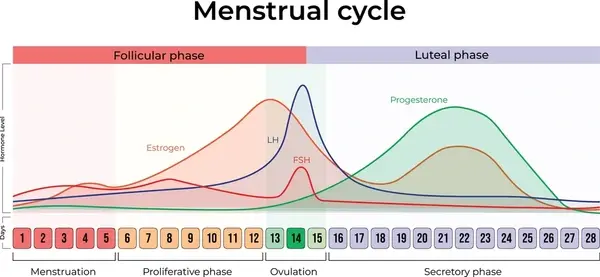
The menstrual cycle is not just a shift in estrogen and progesterone. It is a coordinated shift across three systems that are already more sensitive in this population: the immune system, the connective tissue system, and the nervous system.
Each phase of the cycle changes all three. But not everyone reacts to those changes in the same way.
The same hormonal shift does not produce the same outcome in every body, because it is interacting with systems that already have different thresholds of reactivity. Because each of these three systems has its own baseline sensitivity, the way they respond to estrogen versus progesterone creates distinct, recognizable profiles. This is where patterns start to emerge.
The Estrogen Sensitive Pattern
In this pattern, symptoms intensify when estrogen is rising or at its peak, typically in the late follicular phase and around ovulation.
The underlying mechanism is not simply high estrogen. It is what estrogen does to systems that are already reactive.
Estrogen directly interacts with mast cells, which play a central role in mast cell activation syndrome. It increases their tendency to release inflammatory mediators such as histamine. Research has shown that estrogen and estrogen-like compounds bind to estrogen receptors, which stimulates calcium signaling and induces mast cell degranulation. At the same time, estrogen can reduce the efficiency of histamine breakdown, leaving the body less able to clear these mediators effectively. This is the phase where reactions feel quicker, stronger, and harder to settle once they start.
For someone living with mast cell activation syndrome, this can show up as flushing, itching, headaches, gastrointestinal symptoms, or cardiovascular instability.
At the level of connective tissue, estrogen increases ligament laxity and reduces collagen stiffness. Elevated estrogen levels, as seen during certain phases of the menstrual cycle, can increase ligamentous laxity and joint flexibility. In a body that is already hypermobile, this means less joint stability, more micro-injuries, and a higher mechanical load on the system. That instability does not stay local. It feeds into fatigue, pain, and autonomic dysregulation.
The nervous system is not separate from this. It is responding to both the inflammatory signals and the mechanical instability. In neurodivergent individuals, where sensory processing and regulation are already different, estrogen peaks can feel overstimulating rather than energizing. What is often described as a high energy phase becomes a phase of overload.
So the estrogen sensitive pattern is not just about hormones. It is about an already reactive immune system becoming more reactive, an already flexible body becoming less stable, and an already sensitive nervous system receiving more input than it can comfortably process.
The Progesterone Sensitive or Luteal Sensitive Pattern
Not everyone experiences progesterone as calming, and sensitivity can occur either to its presence or to its withdrawal. In this pattern, symptoms are more prominent in the second half of the cycle, particularly in the days leading up to menstruation.
Progesterone is often described as calming because its metabolites, such as allopregnanolone, interact with GABA-A receptors in the brain. But this description does not capture the full picture. Some individuals are highly sensitive to progesterone or to its metabolites. Instead of producing a calming effect, it can lead to mood changes, cognitive slowing, fatigue, or a sense of disconnection. Research suggests that negative mood symptoms in women with PMDD are caused by a paradoxical effect of allopregnanolone mediated via the GABA-A receptor.
There is another layer that is often overlooked. The late luteal phase is defined by a rapid drop in both progesterone and estrogen. This withdrawal is not subtle. It is a sudden shift in the internal environment.
This drop can destabilize mast cells, leading to increased inflammatory and histamine-related symptoms. Progesterone withdrawal has been associated with seizure exacerbation and other neurological effects, highlighting the significance of this hormonal transition. The drop can also reduce the calming influence that progesterone metabolites have on the nervous system via the GABA-A pathway, making regulation more difficult. Pain sensitivity tends to increase, and tolerance to stress decreases.
To be clear, some individuals react to progesterone itself, finding its presence immediately dysregulating. Others react primarily to the withdrawal, experiencing a sharp spike in symptoms as levels drop. Many experience both layered together. Distinguishing which one is driving your symptoms can change how you approach support.
For individuals with neurodivergence, this can feel like a loss of buffering capacity. Sensory input becomes harder to filter. Emotional regulation requires more effort. Executive function becomes less reliable.
From a connective tissue perspective, this phase often brings increased fatigue and reduced resilience. The body feels less able to compensate.
So the progesterone sensitive pattern is not only about progesterone itself. It is about sensitivity to its effects and to its withdrawal, combined with immune instability and reduced nervous system regulation.
The Mixed Pattern
Many people do not fit neatly into one pattern. Instead, they experience symptoms in both phases, but with different qualities. The pattern is not necessarily worse overall, but rather characterized by phase-dependent shifts in symptom type.
For example, consider someone who experiences flushing, headaches, and increased joint laxity around ovulation, driven by estrogen's effects on mast cells and connective tissue. Yet as they enter the late luteal phase, those specific symptoms might subside, only to be replaced by profound fatigue, brain fog, sensory overload, and emotional lability, driven by the sudden withdrawal of progesterone and its impact on GABA-A receptors.
In this scenario, the quality of symptoms changes entirely across the cycle, rather than just increasing in one direction. The ovulatory phase may bring more inflammatory, allergic, or instability-related symptoms, while the premenstrual phase brings more mood changes, fatigue, and pain.
This reflects the fact that each system responds differently to hormonal shifts. The immune system, connective tissue, and nervous system are all being modulated at the same time, but not in the same direction or with the same intensity.
This is why the experience can feel inconsistent or unpredictable, even when there is an underlying pattern. It is also why PME and PMDD can overlap. An individual may have an underlying mast cell activation flare, which is a form of PME, and a heightened mood response that resembles PMDD in the same cycle.
Summary Table for Quick Reference
The table below provides a quick-reference guide to the three patterns, their key hormonal drivers, common systemic signs, and focus areas for support. To use this table, start by scanning for the symptom clusters that feel most familiar to you, then match those clusters to the phase of your cycle where they typically appear.
Pattern | Key Hormonal Driver | Common Systemic Signs |
Estrogen Sensitive | Rising or peak estrogen, typically in the late follicular phase and around ovulation | Mast cell flares, flushing, itching, headaches, joint laxity, sensory overload, high-energy crashes |
Progesterone Sensitive | Progesterone presence or sudden withdrawal, typically in the luteal phase | Fatigue, brain fog, loss of executive function, deep joint aches, low buffering capacity, emotional changes |
Mixed Pattern | Both phases shifting across the month | Alternating between inflammatory and laxity peaks in the first half and cognitive and fatigue crashes in the second half |
Why This Matters for Management
If you approach the menstrual cycle as a single hormonal issue, management will often feel ineffective.
What actually needs to be addressed is the dominant sensitivity, and recognizing that this may shift across the month. The strategies below are organized to help you identify which system is driving your symptoms and what you can do about it.
For many people, it is a combination of all three systems. That is why a layered approach, one that addresses immune reactivity, connective tissue stability, and nervous system regulation separately, provides the clearest picture. You do not need to do everything at once. Start with the tools that target your most disruptive symptom.
Why This Matters for Management
If you approach the menstrual cycle as a single hormonal issue, management will often feel ineffective.
What actually needs to be addressed is the dominant sensitivity, and recognizing that this may shift across the month.
If mast cell reactivity is the primary driver, support needs to focus on stabilizing the immune response, particularly around known trigger phases. You can start by categorizing your symptoms into three groups.
Inflammatory symptoms include rash, flushing, or gastrointestinal distress.
Structural symptoms include joint instability or pain.
Neurological symptoms include mood changes, sensory overload, or brain fog.Over time, these clusters reveal which system is driving which phase.
If connective tissue instability is more prominent, physical load, joint support, and movement strategies may need to be adjusted across the cycle. Experiment with modifying your physical load. Consider lower-impact movement or gentler dynamic stretching during high-estrogen phases when laxity peaks. During the luteal phase, prioritize rest and recovery to match your reduced mechanical resilience.
If nervous system sensitivity is the main factor, regulation strategies, sensory input, and cognitive demands need to be adapted to the phase of the cycle. Use the luteal phase to reduce cognitive and sensory demands where possible. Protect your downtime, lower external input, and build in more recovery time. Track when your sensory filters feel thinnest and plan your environment accordingly.
For many people, it is a combination of all three. That is why a layered approach, one that tracks inflammatory, structural, and neurological markers separately, provides the clearest picture.
This is why tracking becomes essential. But if you are overwhelmed, start small. Track just one cycle, focusing only on when symptoms peak and what type they are, rather than trying to capture everything at once. Once that feels manageable, you can add more layers.
Over time, patterns become clearer. What initially feels random starts to show structure. Pattern recognition reduces unpredictability, even when it does not remove symptoms entirely.
And once there is structure, there is something to work with. That is what we program into our management protocols at ParaMotion so that we give the best care for our clients across their cycles.
If you’d like help creating a movement or support plan that fits your nervous system and connective tissue needs, we are here to support you.
👉 [Book your Free 15 mn call here!!] we’ll talk about what’s possible for your body, at your pace.



Comments